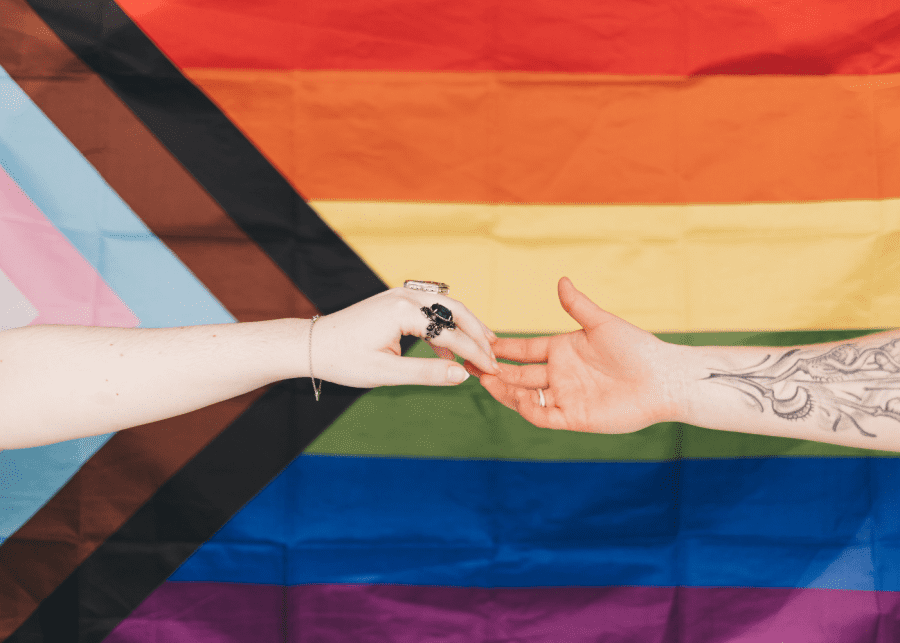
Can you be gay and religious? I speak to three people to find out how they reconcile their faith and sexuality.
The relationship between religion and sexuality has always been tumultuous. For the longest time, the two ideologies butted heads any time they came up in the same conversation. We’re often barraged with ideas of what the perfect family looks like. To stray from that path meant condemning yourself to a life of eternal damnation (I exaggerate for effect). Interpretations of religious script often equate queerness with immorality. And while we strive to keep things secular state-wise, we can’t police what people inherently believe.
I grew up with a loose attachment to religion. While my mother is a devout Catholic, my father is a free thinker. My siblings and I were left to our own devices to figure out religion for ourselves, which I am immensely grateful for. I never personally fought the turmoil of reconciling my own queerness with religious beliefs. But it’s a topic that remains very close to my heart. What happens when religion, a source of comfort and solace to most, ends up becoming the root of fear for someone else?
I chat with queer Buddhist, Christian, and Muslim individuals to understand their thoughts. And no, this isn’t the start of a bad knock-knock joke. Instead, it’s a glimpse of enlightening conversations that look into bumpy spiritual journeys, communities, and staying authentic.
“In my mind, I remember, ‘God prefers me alive rather than dead’. That keeps me alive.”
An Ding, 35, Christian & Buddhist
Growing up in a family of free thinkers, An Ding didn’t subscribe to any particular religion until she was 18. After bouncing from an evangelical megachurch and Presbyterian church, she found herself at Free Community Church. For anyone not in the loop, it’s Singapore’s only queer-affirming church. Through the discovery of her own identity, An Ding got a glimpse into perspectives of sexuality and religion. While the road to acceptance is a rocky one, she’s learning to embrace her identity.
“I had crushes as a teenager, and experimenting with a girl at 18 made me realise I was gay. We broke up at church because she felt guilty about it and confessed it to our cell group leader, which I was sad about. But I took it on the chin and moved on. As I become curious about my gayness and Christianity, I explored online forums and made friends with other gay Christians. I even turned to conversion therapy because I wanted to find others who identified the same way I do.
“I’ve read both queer-affirming and non-affirming theology, and it’s an interesting experience as both sides are very convincing. I swung back and forth, with my partner being patient and tolerant of periods of celibacy when I felt convicted by God. I sometimes still can’t reconcile me being gay and Christian, even when I choose to read the Bible from a queer-affirming lens. Buddhism now seems like a kinder option, as I’ve found compassion from my Buddhist friends and a nun who spoke words of kindness over me. In my mind, I remember, ‘God prefers me alive rather than dead’. That keeps me alive.”
“Authenticity demands that you live your life without pretence or self-deception. That, to me, is holiness.”
Sophia, 28, Christian
Sophia likes to jokingly credit her Buddhist grandmother for leading her down the path of Christianity. While her fondness for religion started from a place of convenience, where her education took place within Catholic institutions close to her home, she was enamoured by stories of God. Specifically, the love and compassion shown through the Bible. Some Christians may not have shown her the same kindness, but it hasn’t stopped her from practising what’s important to her.
“The usual rhetoric of homosexuality being a sin is prevalent in religious institutions, but I don’t let it deter me from attending church. I struggled with balancing being true to myself and true to what I was being taught. Some days I felt like I was ruining my chances of going to heaven. On other days I’d wake up with the conviction that nobody except God had a real say in the direction of my life and my choices. I don’t fear being turned away at the gates of heaven.
“As for my religion and sexuality, I don’t think they’ve even shaken hands yet! I’m learning every day what it means to be true to myself and to always say what I mean. My closest friends all know how I feel about my faith, and it’s a wonderfully cerebral experience. I realised that hiding parts of myself and tailoring my personality won’t do me any good. And since I’ve stopped putting up pretences, I’ve had an easier time navigating myself. I might never reconcile these parts of me, and I don’t believe God begrudges me for it. Authenticity demands that you live your life without pretence or self-deception. That, to me, is holiness.”

“I’m keen to be a part of that and become a person who’s both queer and Muslim. I foresee the journey to be long with plenty of tears. But you know what? Bring it on.”
Razali (not his real name), 40, Muslim
Despite taking religious classes during his formative years, Razali remained resistant to religion. Acts like fasting and annual alms were done at face value, and prayers weren’t strictly enforced in his household. Over the years, his bitterness towards religion has turned into peaceful co-existence. Now, he focuses on his healing journey, taking it one step at a time.
“I’ve always known that I’m queer. When it became compulsory to fulfil my religious obligations, I did them on and off, then I stopped entirely. My mindset at the time was, ‘I’m already gay; it doesn’t matter if I do them or not. I’m still going to hell’. I also felt like a fraud since I’m ‘living in sin’. After all, how can I be a Muslim and still be queer? I’ve always been taught that homosexuality is wrong and that God doesn’t recognise homosexuals on the Day of Judgement.
“I haven’t reconciled my sexuality and religion; I live my life as I always have. I discarded my religion in favour of my queer identity at first, but my anger and resistance towards religion have mellowed out a bit. There’s a queer Muslim community that aims to help people like me reconcile sexuality and faith. I’m keen to be a part of that and become a person who’s both queer and Muslim. I foresee the journey to be long with plenty of tears. But you know what? Bring it on.”
The light at the end of a bleak tunnel
An Ding, Sophia, and Razali’s stories are just a handful of experiences that illustrate what it’s like to be on the path towards reconciling religion and sexuality. Their struggles are unique because a journey that challenges social norms and confronts traditional beliefs can’t be generalised. It’s a long way to embracing diametrically opposing aspects of your identity. But, as Sophia says, staying authentic is the kindest thing you can do for yourself.
Got a story about reconciling religion and sexuality? DM us on Instagram or email us at hello@thehoneycombers.com. We’d love to hear from you.