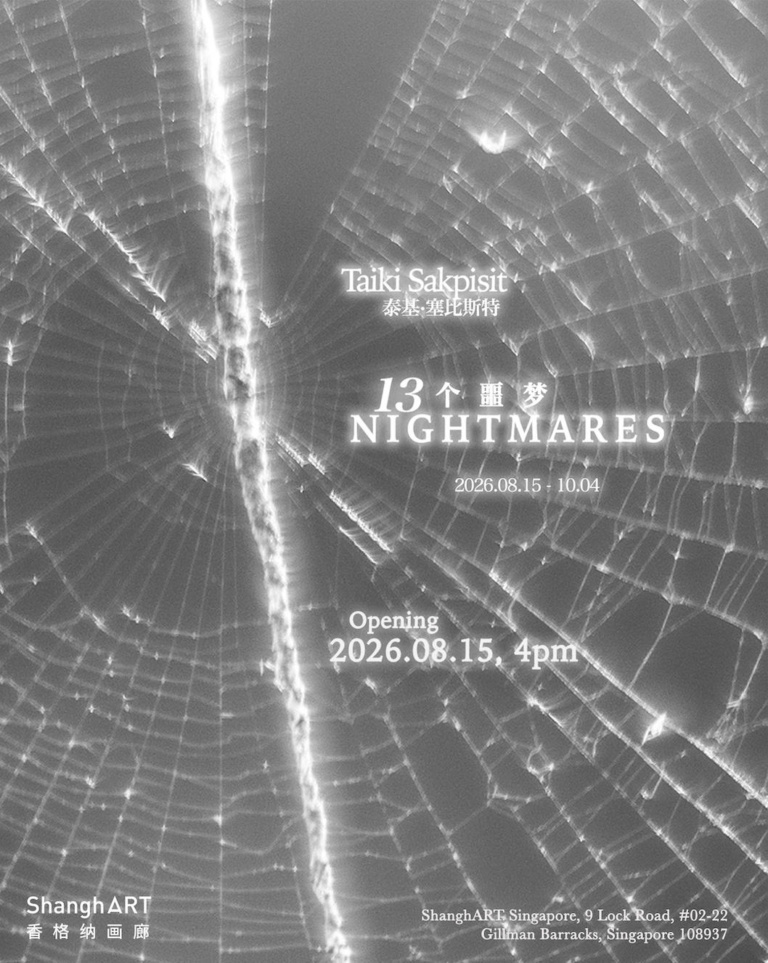
Opening Reception : 15 August 2026, 4pm
Exhibition Period : 15 August 2026 – 4 October 2026
ShanghART Singapore presents 13 Nightmares by Taiki Sakpisit, opening on 15 August 2026. Over the past two decades, Sakpisit has developed one of Southeast Asia’s most distinctive practices, dissolving the boundaries between cinema and contemporary art. Frequently drawing upon Thailand’s histories, folklore and political imaginaries, Sakpisit’s works are rooted in the unstable terrain where personal memory and collective consciousness continually intersect.
The premise of this exhibition can be traced back to a nightmare Sakpisit experienced in Singapore in 2018. A phone call from his brother awoke him from the nightmare, informing him about the passing of a family member. Since then, Sakpisit has become increasingly drawn to the intersections between dreams, memory, grief, and premonition, culminating in this exhibition.
In his first solo exhibition with ShanghART Singapore, Sakpisit transforms the gallery into a labyrinth of moving images, photography, sound and spectral presences. A series of photographic works appear as snapshots and fragments from different realities, layering upon one another. Drawn from the artist’s collection of photographs shot over the past few years as a core part of his working process, the images form a quiet yet intense distillation of Sakpisit’s memories and encounters with place and history.
Anchoring the exhibition, the two-channel installation transforms cinematic language into a spatial, sculptural, and psychological encounter. Within this shifting landscape, animism, supernatural presences, and altered states appear as recurring motifs through which Sakpisit evokes fear, vulnerability, and the persistence of the unconscious. Together, they construct a landscape haunted by historical trauma and contemporary anxieties.
Working across experimental film, photography, and installation, Sakpisit continues to expand cinema beyond the conventions of projection, inviting audiences to inhabit images physically and experience the moving image as an environment rather than a sequence of projected frames. Rather than following a linear narrative, visitors navigate the exhibition as they might recall a dream: through fragments, repetitions and sudden dislocations.