Wondering how much it costs to live in Bali? Here's the breakdown, from rent and food to transport, coworking and the extra fees nobody mentions.
I moved to Bali from Jakarta expecting it to be the cheaper option, and in a lot of ways it is. But it’s astonishing how quickly you can spend without noticing. The flat whites, the smoothie bowls, the Sunday beach clubs – they all add up while you’re busy telling yourself you’re being sensible (guilty!). The truth is, the cost of living in Bali has an enormous range, and a lot of your monthly spend comes down to whether you live more like a local, or like a tourist. A latte in Canggu can cost double what you’d pay in Denpasar, though it usually comes with a rice-field view and a queue to match. So, while living well here is very much doable, “cheap” depends entirely on how you live.
Here’s the honest breakdown of what a real month in Bali costs, and how to stop the island from driving you into personal bankruptcy.
Why trust this guide?
Hello! I’m Erick, and I’ve been living and working in Bali for over a year now. All the pricing in this guide comes from my own experience – I’ve done the supermarket rounds and compared prices down to the last thousand rupiah (yes, really). I rented a scooter before eventually buying my own. I’ve moved between a couple of different places to live, and worked from more coworking spaces than I care to admit. So, this is what I actually spend in Bali, and what I’d tell a friend who was thinking of making the move.
Cost of living in Bali for digital nomads at a glance
A comfortable month in Bali costs most solo nomads around IDR 25 to 40 million (roughly USD 1,400 to 2,200). Live simply and you can do it on IDR 17 million. Chase the pool villa and the beach clubs and you’ll sail past IDR 50 million. Here’s where it goes:
Rent: IDR 7 to 18 million, your biggest cost by a mile
Food and groceries: IDR 5 to 9 million, the line that swings most
Transport: around IDR 1.7 million for a scooter and petrol
Internet: IDR 500,000 to 900,000 for a SIM and home wifi
Coworking: IDR 1 to 2 million or just cover your coffee tab at cafes
Health insurance: IDR 900,000 to 1.8 million, don’t skip it
The fun stuff: IDR 2 to 6 million, entirely up to you
Extra costs: deposits, electricity, visa and local fees
Check out these three sample budgets for real monthly costs, from lean to plush
More for your move to Bali:
- The complete guide to being a digital nomad in Bali
- Digital nomad visas in Bali
- The best coworking spaces in Bali
How much is rent in Bali?
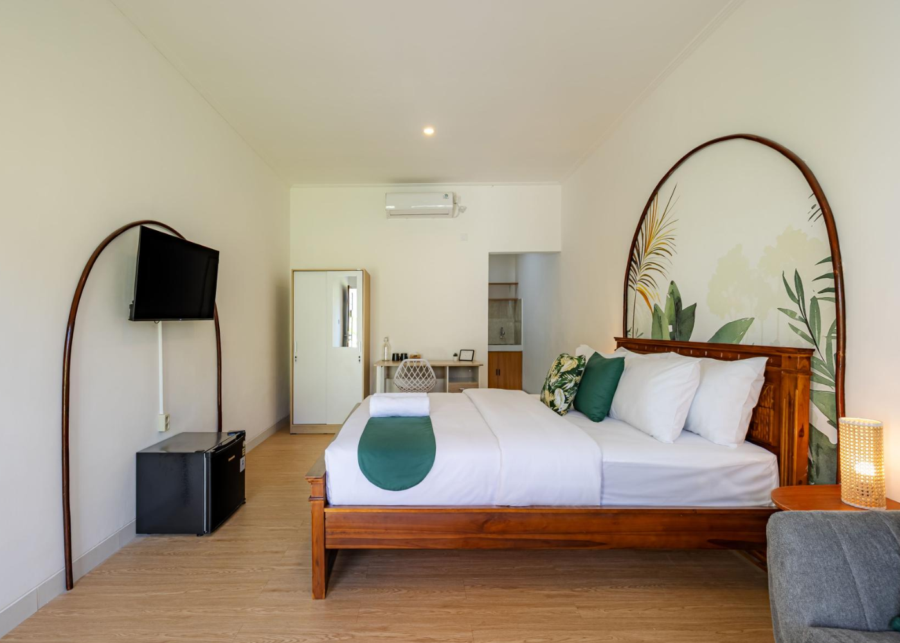
Accommodation is the line worth getting right, because it’ll dominate your monthly spend. Expect to pay IDR 7 to 18 million a month for a comfortable one-person setup. That’s the honest range, and where you land inside it depends on two things: what kind of place you want and which corner of the island you want it in. Here’s how the options stack up:
Coliving
The easiest way to set up base, especially for your first month or two, is to colive. You get a room with the wifi already sorted, a built-in community, and none of the commitment of a year-long lease before you even know the island. Budget options like Cove start at around IDR 6 to 9 million per month, while the fancier end climbs to IDR 10 million and up. It’s a somewhat expensive way to buy simplicity, but for a soft landing it’s hard to beat.
Villa rental
The Bali dream, and the one most people eventually chase. A modest one-bed villa costs anything between IDR 10 to 18 million per month, while anything with a private pool in Canggu or Seminyak starts around IDR 20 million and climbs from there. Fair warning though, “villa” is a very generous word here. It covers everything from a beautiful open-plan place with a pool and garden, to a slightly damp box with a decorative plunge pool. Always view before you commit.
Kos and guesthouses
Here’s the local option, and if you’re Indonesian like me, it might be your best-value move. A kos is a locally rented room, usually simple, usually with a private bathroom and AC, and often just IDR 2 to 5 million a month. You won’t get a pool or an infinity view, but you’ll get a clean, functional base for a fraction of the price of anything marketed at foreigners. Guesthouses sit a step up, a bit more comfort, yet still far cheaper than a villa, and they’re the option most budget-conscious digital nomads end up in.
Note: If you’re a foreign passport holder, the kos route is largely off the table. Badung regency (which covers Canggu, Seminyak, Kerobokan and Kuta) prohibits foreigners from staying in kos-licensed properties, and enforcement has tightened.
Monthly hotels and Airbnb
Convenient, but expensive – booking nightly on Airbnb or in a hotel can easily cost double what you’d pay for a monthly rate, so if you’re staying more than a couple of weeks, always reach out to the property directly for a monthly price. Most owners have one, and most will drop the rate significantly if you ask.
At the end of the day, it comes down to where you want to live. Every area and every type of place has its own trade-off. Canggu and Seminyak sit at the top of the price range, Pererenan is climbing fast now that everyone’s discovered it, while Ubud and Sanur are gentler on the wallet. Denpasar is cheapest of all. As a Sanur resident, I’d say the savings here are real, and the traffic is a fraction of Canggu’s, but you can read more on that in my complete digital nomad guide.
How much does food cost in Bali?
Budget IDR 5 to 9 million a month for food and groceries. This is the line that swings hardest, because it’s entirely about how you eat.
Eating out in Bali
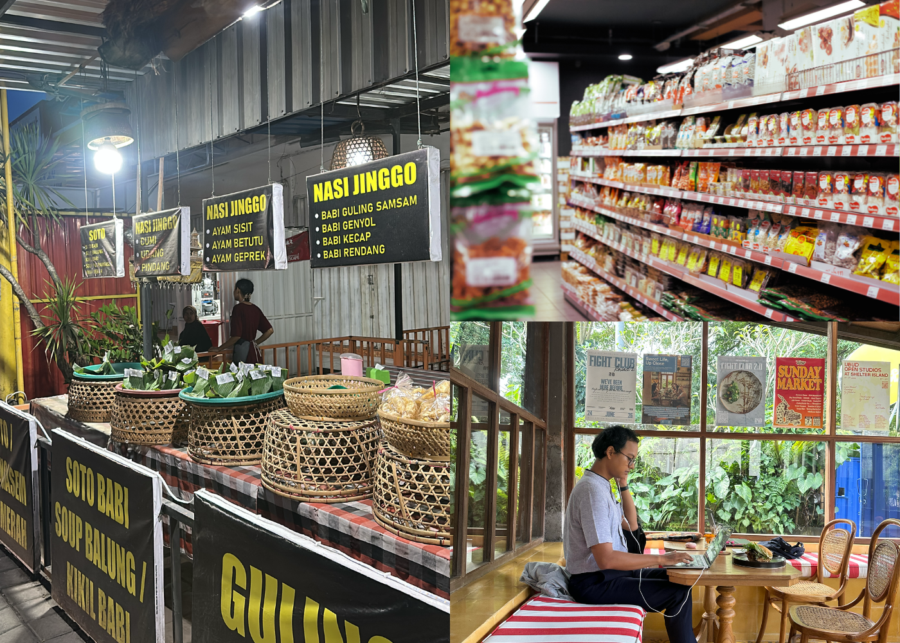
Eating out is where your food budget lives or dies, and Bali gives you the full spectrum. At the bottom end, a warung meal of proper Indonesian food costs around IDR 20,000 to 50,000, and for me personally, it’s the best value on the island. Local coffee at a warung or kopi shop is IDR 20,000 to 40,000. Step up to a mid-range restaurant and you’re at IDR 80,000 to 150,000 for a main, while a cafe brunch with a specialty coffee lands around IDR 150,000 to 250,000. Beach clubs and fine dining are their own category entirely, so budget accordingly if that’s your weekend.
My honest advice: Eat local most days, treat the smoothie bowls and brunches as a weekly thing rather than a habit, and the numbers will work out fine. The food’s better at the warung anyway, and I’m not just being patriotic about that.
Where to buy your groceries
Bali’s grocery scene works in tiers, and knowing which one you’re in saves real money.
- Traditional markets (pasar) – The cheapest by a mile for fruit, vegetables, eggs and spices, and fresher than anything on a supermarket shelf. Schedules vary a lot though: some open as early as 5am and are winding down by mid-morning, while others don’t get going until the evening, so learn the rhythm of the one nearest you before you turn up to an empty stall. Bring cash and small notes, and haggle a little unless prices are marked. Note: Most vendors won’t speak much English, so a few words of Bahasa go a long way (and are very appreciated).
- Local supermarkets – Bintang Supermarket and Tiara Dewata are the affordable, easy options where locals actually shop (including me). Everything you need, without the imported markup. They might not be as stocked up on imported goods as the premium supermarkets though, but hey, I’m not picky about my cheese.
- The premium supermarkets – Pepito, Grand Lucky and Frestive stock the imported comforts: the cheese, the wine, the granola, and price them accordingly. Papaya is worth knowing about too – it’s a Japanese specialty store, so it’s excellent for sushi-grade fish and Japanese ingredients.
- Minimarts – Alfamart, Indomaret and Circle K are on practically every corner for snacks, water, SIM top-ups and whatever you forgot. Convenient and cheap, but not the place for fresh produce.
How much does transport cost in Bali?

Budget IDR 1 to 1.5 million a month for a scooter to get around (plus petrol, call it IDR 1.7 million all in). That’s it. Transport is the one line where Bali is relatively cheap.
Renting a scooter
The scooter is how Bali moves, and for most nomads it’s non-negotiable. A basic automatic (a Vario or a Scoopy, the ones you’ll see everywhere) rents for IDR 1 to 1.5 million a month, usually including a helmet and basic insurance. Rent by the month rather than the day, since the daily rate is around IDR 70,000 to 100,000 and adds up fast. Petrol is cheap, around IDR 200,000 to 300,000 a month depending on how much you ride.
Bigger bikes and newer models cost more, and if you want something like a PCX or an ADV, expect to pay closer to IDR 2 million a month.
Driving in Bali: you legally need an International Driving Permit with a motorcycle endorsement, alongside a valid motorcycle licence from home. Police checkpoints are common and enforcement has tightened, so riding without one risks a fine – not to mention, you’ll be putting everyone else on the road at risk if you don’t have experience. It also voids your travel insurance if you have an accident without a proper licence, so get the paperwork and wear the helmet.

If you’d rather not ride
Fair enough, Bali traffic isn’t for everyone. Gojek and Grab (the local ride-hailingapps) cover most of the island and can be quite cheap. A short motorbike ride is IDR 15,000 to 25,000, and a car trip across town might be IDR 50,000 to 100,000. Both apps also deliver food, which you’ll use more than you expect. You can absolutely live here without a scooter, particularly in a walkable base like Sanur or Ubud centre. It’s just less convenient, and in areas with patchy driver coverage you’ll occasionally be waiting.
Renting and hiring cars
A car with a driver costs around IDR 800,000 a day, which is worth it for a day trip. Self-drive rental is cheaper, around IDR 300,000 a day, though I’d only recommend it if you’re comfortable with how Bali drives. You can also hire a driver for shorter trips (like an airport pickup), which will be priced on the distance, rather than a full-day price.
Good to know: Whatever you rent, take photos of the vehicle when you pick it up. Every scratch, every dent – it’ll save you an argument (and a deposit) when you hand it back.
What does internet cost in Bali?
Budget IDR 500,000 to 900,000 a month for staying connected. Bali’s internet is actually way better than you’d expect.
Your SIM card
Telkomsel is the most reliable network on the island, and a 50GB data package costs around IDR 150,000 a month. You can pick up a SIM at the airport, but it’s cheaper at any official Telkomsel store or a minimart, and topping up takes about two minutes in the app. XL and Indosat are cheaper alternatives with slightly patchier coverage, which is fine in Canggu or Denpasar, but less fine if you’re out in the hills.
Local tip: Get an eSIM if your phone supports it. You can set it up before you land and skip the admin entirely.
Home internet
If you’re renting long-term, fibre is the way, and most villas and coliving places already have it. Expect IDR 400,000 to 700,000 a month for a decent connection, and often it’s bundled into your rent. Speeds of 50 to 100 Mbps are standard in the main nomad areas, which handles video calls and big uploads without drama. Ubud seems a little slower than by the coast, though it’s improved a lot. Out in the quieter corners of Bali, coverage can get patchy enough that some people go for Starlink, which costs more but solves the problem.
Good to know: Power cuts happen, especially in the wet season, and they take the wifi with them. Keep a data-loaded SIM as a backup so you can hotspot your way through an important call. That, and a charged laptop, has saved me more than once.
Do you need to pay for coworking in Bali?
Budget IDR 1 to 2 million a month if you want a coworking membership. Skip it and work from cafes instead, and your only cost is what you order. This is the most optional line in your whole budget, and it comes down to how you prefer to work.
Working from cafes
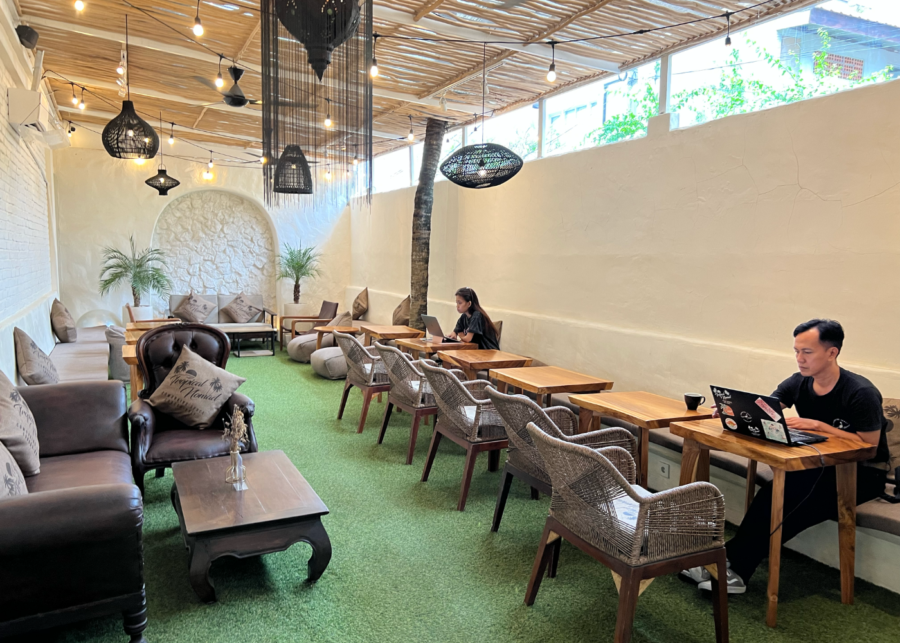
Bali is known for its cafe culture, and plenty of nomads never pay for a desk at all. A coffee costs IDR 25,000 to 45,000, so if you buy a couple and stay a few hours, you’re working for the price of your caffeine habit anyway. Some spots are set up for it, with plugs, fast wifi and staff who won’t glare at you for camping out.
The catch is that cafes are unpredictable. The wifi might crawl at lunchtime, the table might be too small, and taking a video call in a busy room is nobody’s idea of professional. Fine for a light day, less fine when you’ve got back-to-back meetings.
Paying for a coworking space in Bali
A monthly membership typically costs IDR 1 to 2 million, with day passes from around IDR 100,000 to 300,000. For that you get reliable wifi, aircon, a chair that won’t wreck your back, call booths, and a community that makes the whole thing less lonely. If you’re here for a month or more and you work full-time, maybe it’s best to get a membership. The math works out fast once you’re buying three coffees a day to justify a cafe table, and the productivity difference is real. If you’re here for a week or you work light hours, day passes or cafes are plenty.
Good to know: A few spaces charge nothing for the desk as long as you’re ordering from their cafe (like ZIN@Work and Tribal in Canggu), which offers the best of both worlds.
I’ve broken down every option in our full guide to the best coworking spaces in Bali.
What about health insurance in Bali?
Budget IDR 900,000 to 1.8 million a month, and please don’t skip this one. Nomad-focused insurers like SafetyWing and Genki are the usual picks, since they’re built for people who move around and they’re easy to sign up for from anywhere. Expect roughly USD 50 to 100 a month depending on your age and what’s covered.
Here’s why insurance matters in Indonesia:
Public healthcare in Bali is basic, so foreigners generally end up at private international hospitals like BIMC, Siloam or the new Bali International Hospital. Surgery from a scooter accident can cost you well over $30,000. And scooter accidents are, statistically, how most nomads end up in hospital here. If you’re riding without the correct licence, most travel insurance companies won’t pay out at all. That turns a bad day into a financially catastrophic one.
Good to know: Check that your policy actually covers motorbike riding, since plenty of standard travel policies exclude it or require a valid licence. Read that clause before you sign, not while you’re sitting in the emergency room.
The fun stuff (and where budgets go to die)

We all need leisure activities. Why would you move to one of the most beautiful islands in the world and not enjoy what it has to offer? Budget IDR 2 to 6 million a month, and this is entirely on you. Here’s roughly what things cost:
- Gym membership: IDR 500,000 to 2 million a month, depending on how fancy you go
- Yoga class: IDR 100,000 to 180,000 for a drop-in, with monthly passes working out cheaper
- Massage: IDR 100,000 to 200,000 for an hour at a local spa, and considerably more at a hotel one
- Surf board rental: around IDR 50,000 to 100,000 a day
- A night out: IDR 500,000 to 800,000 once you factor in drinks, and far more at a beach club
- Beach club day bed: minimum spends often start around IDR 500,000 and climb steeply
None of this is expensive on its own. But that’s the problem. It’s the third latte, the spontaneous beach club and the “it’s only IDR 150,000 for a massage” that eat into the budget. So no, I’m not telling you to skip any of it. Go surf, get the massage, say yes to the beach club. Just know this is the line that moves most, and the one that’ll surprise you when you finally add it to your cost of living in Bali.
The extra costs to budget for
Once you’ve sorted the big expenditures, there’s a handful of smaller costs that tend to catch people out. They’re the ones nobody mentions, partly because locals take them for granted, and partly because they’re sometimes bundled into your rent without you realising. So here’s what to set aside for:
- The deposit – Two months upfront is now standard for a villa in Canggu, and some long leases still expect six months or even a full year paid in advance. That’s a serious chunk of cash to have ready before you’ve earned a single rupiah here, so factor it into your moving costs, not your monthly ones.
- Electricity – Usually separate from your rent. For a single person in a modest place, it’s not much. Mine comes to around IDR 300,000-400,000 a month. Where it climbs is with a bigger villa, and especially a private pool, since the pump runs daily and eats power. You could be paying well over IDR 1 million per month, depending on your usage.
- The visa – The E33G remote worker visa costs IDR 7 million just in government fees, and a lot more if you use an agent. Spread over a year that’s not much, but it’s a real upfront cost people forget to budget for.
- Local fees – The small ones that most foreigners forget about. Parking attendants expect IDR 2,000 to 5,000 pretty much everywhere you stop. Rubbish collection is a separate monthly charge (approx IDR 150,000). And in many neighbourhoods there’s uang banjar – a contribution to the local community organisation that looks after the area, from ceremonies to security. None of it is expensive, but nobody tells you in advance, so ask your landlord what’s expected before you move in.
Sample cost of living in Bali for digital nomads
Budget | Comfortable | Plush | |
The setup | Guesthouse or budget coliving in Sanur or Ubud, warungs most days, working from cafes | A decent one-bed, a mix of warungs and cafes, coworking membership, proper weekends | Private pool villa in Canggu or Seminyak, mostly Western dining, dedicated desk, drivers on call |
Accommodation | IDR 7,000,000 | IDR 12,000,000 | IDR 25,000,000 |
Food and groceries | IDR 4,000,000 | IDR 7,000,000 | IDR 12,000,000 |
Transport | IDR 1,700,000 | IDR 1,700,000 | IDR 3,000,000 |
Coworking | - | IDR 1,500,000 | IDR 3,000,000 |
Internet and SIM | IDR 600,000 | IDR 800,000 | IDR 1,000,000 |
Insurance | IDR 900,000 | IDR 1,200,000 | IDR 1,800,000 |
Leisure | IDR 2,000,000 | IDR 4,000,000 | IDR 6,000,000 |
Monthly total | ~IDR 17,000,000 | ~IDR 29,000,000 | ~IDR 52,000,000 |
In short, the cost of living in Bali can be cheap or expensive, and both versions are valid. Work out which one you’re actually buying into, keep an eye on the first month, and you’ll be fine.
See you at the warung!